A Fresh Wort Kit is designed to give the same result every time: 20 litres of fully boiled, water-adjusted wort, yeast in the box, and instructions you can follow without thinking. But after a few brews, many people want something more. A stout with a whisky character, a pilsner with more hop aroma, an IPA with mango.
The good news is that the wort is an excellent starting point for experimenting. The brewery has done the hard part – mashing, boiling and water adjustment – and everything you change happens on the cold side: which yeast you use, and what you put in the fermenter afterwards. Here is what works, how much to use, and which kits are best suited.
In short
A Fresh Wort Kit can be changed in four ways without touching the wort: different yeast, fruit purée, oak and dry hops. Fruit purée is added after high krausen, typically 1–4 kg per 20 litres. Oak gives a clear character with 30–60 g of cubes or chips for two to four weeks, and can be soaked in whisky or aquavit first. Dry hops give the most aroma in the first one to three days. Imperial Stout is the kit with the most room for experimenting, but Bohemian Pilsner and Sunset Sipper IPA can also take a lot.
What can you change in a Fresh Wort Kit?
You can change everything that happens after the wort is in the fermenter. The wort itself – malt, hop bitterness and strength – is set by the brewery, and no water should be added either. That gives you four levers to pull:
- The yeast determines fruitiness, spice, dryness and alcohol content.
- Fruit adds flavour, aroma and colour, plus a little extra alcohol.
- Oak adds vanilla, caramel, spice and tannin, and brings flavour from spirits if it has been soaked in them.
- Dry hops add aroma without extra bitterness.
You can also use additions such as lactose for a sweeter body, or spices like orange peel and juniper berries. Many of the same principles are covered in our article on using additions when brewing beer.
Which yeast gives which flavour?
The yeast is the simplest change, and often the one that makes the biggest difference. The same wort becomes two different beers with two different yeasts. An experiment from Brülosophy, in which the same pale ale was fermented with US-05 and with the lager yeast W-34/70 at 19°C, showed that tasters could clearly tell the beers apart.
The most important thing to know is that the yeast also controls how far the beer ferments out. High attenuation gives a drier beer and more alcohol; low attenuation gives a fuller, sweeter beer.
| Yeast | Temperature | Attenuation | Gives |
|---|---|---|---|
| Voss kveik | 25–40°C | 76–82% | Orange and citrus, finished in 2–4 days |
| High Voltage | 31–35°C | 76–80% | Clean, almost lager-like, tolerates 17% alcohol |
| NovaLager | 10–20°C | 78–84% | Clean lager profile at ale temperature |
| Nottingham | 10–25°C | 78–84% | Neutral and dry, tolerates 14% alcohol |
| BE-134 | 18–26°C | 89–93% | Saison: pepper, spice, very dry |
| Philly Sour | 20–30°C | – | Sour beer in one step, tolerates hops |
A worked example shows how much attenuation matters. A wort with an OG of 1.060 ends up at about 5.4% with a yeast that attenuates 68%, and about 7.1% with a yeast that attenuates 90%. Always measure the final gravity with a hydrometer before packaging.
Kveik is the most exciting swap for many, because it finishes fermenting in a few days at high temperature. Read more in the articles on brewing with kveik and on pilsner in three days with High Voltage.
How much fruit purée should you use?
For a 20 litre kit, 1–4 kg of fruit purée is a good range. The American Homebrewers Association gives 30–240 g per litre for raspberries and cherries, and 30–120 g per litre for citrus. Intense fruits such as passion fruit and blackcurrant need the least, mild fruits such as strawberry and peach the most.
Our 1 kg fruit purées are pasteurised and can be poured straight into the fermenter. Add them after high krausen, typically after about a week, and let the beer ferment for at least another week. That way the yeast gets to eat the sugar from the fruit before you package, and you keep as much of the fresh fruit aroma as possible.
Fruit adds a little extra alcohol. A purée contains about 10% sugar, so 2 kg of purée in 20 litres adds about half a percentage point. Fruit also takes up space and creates a new krausen, so the fermenter should have plenty of headspace. There is more on fruit in the article on brewing beer with fruit.
If you want fruit flavour without extra fermentation, there is 20 ml fruit essence. One pouch is intended for 20 litres and is added after fermentation.
How do you give beer oak and whisky character?
Oak adds vanilla, caramel, coconut and spice, plus a little tannin that gives structure. American oak gives more vanilla and caramel, French oak is more subtle and spicy. Oak cubes from whisky barrels already have whisky character in the wood.
The dose is typically 15–75 g per 20 litres, according to Brew Your Own. A Brülosophy experiment with 60 g of cubes in a strong bitter gave a clear oak character in just two weeks, and another found no difference between two weeks and two months on cubes in a porter. Chips extract faster than cubes and are easier to overdo.
Research by Sterckx and colleagues shows that oak is extracted faster in beer with high alcohol and low pH. An imperial stout above 9% therefore gets more oak character per gram than a light ale. Start at the lower end of the dosage range and taste weekly.
1. Soak the oak in spirits
Put the oak in a clean jar and cover it with whisky, bourbon, rum or aquavit. The spirit sanitises the oak and picks up flavour at the same time. Leave it for anything from a few days to two weeks. Aquavit is our own suggestion: caraway and anise go well with dark, roasted malt, but there are no technical sources on it.
2. Decide whether to add the spirit
You can add just the oak, or the oak together with the spirit. The spirit also contains oak flavour. If you want more spirit in the beer, taste your way there with a splash in a glass of beer before adding the rest.
3. Add the oak after fermentation
Put the oak in a sanitised hop bag so it is easy to remove. Leave it for two to four weeks, tasting every week. When the flavour is where you want it, take it out.
How do you dry hop a kit?
Dry hops add aroma without bitterness and suit any hop-forward kit. A typical dose for an IPA is around 7 g per litre, i.e. about 150 g for 20 litres. For a pilsner, 1–1.5 g per litre is enough, as in an Italian pilsner.
Research from Oregon State University shows that most of the aroma has been extracted after one day. Long contact time gives more grassy and spicy flavours. Two to five days is therefore enough, and colder is better than warmer.
Cryo hops are concentrated lupulin, and you use half the weight of regular pellets. HopBurst is a hop oil added after fermentation, one pouch per 20 litres, with 2–24 hours of contact time. There is more on hop varieties and timing in the article on brewing and hops.
Why is Imperial Stout the best choice?
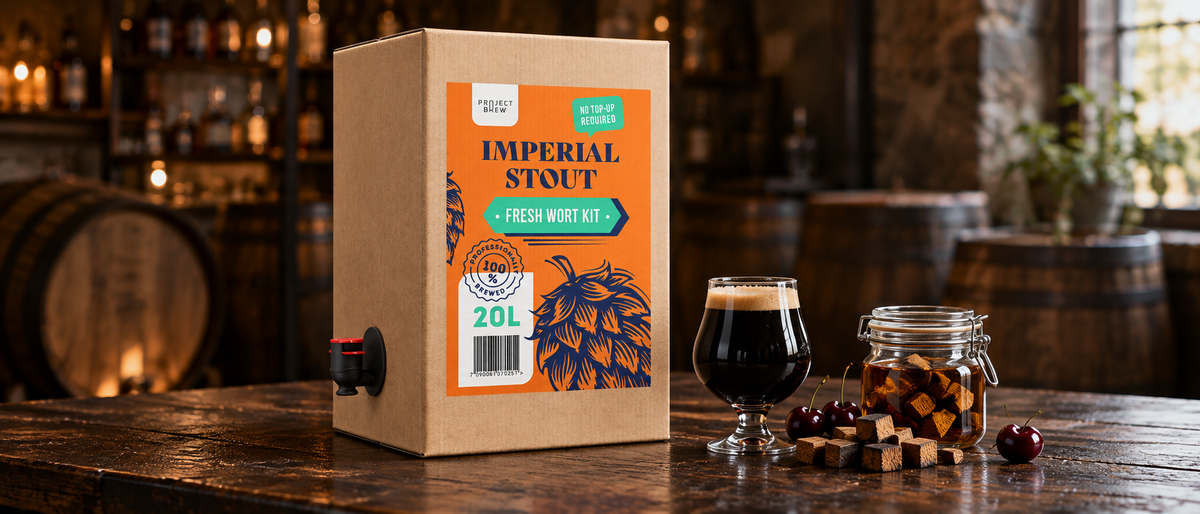
Imperial Stout 20L Fresh Wort Kit has an OG of 1.101, an FG of 1.030 and 9.4% ABV, with flavours of chocolate, coffee and roasted malt. Big beers can take big additions, and an imperial stout benefits from months of conditioning anyway. Brew Your Own recommends six months or more.
- Whisky oak: 40–60 g of whisky cubes for two to four weeks after fermentation.
- Aquavit oak: 30–50 g of American chips soaked in aquavit, one to two weeks. Chips extract quickly in a 9% beer.
- Cherries or raspberries: 1–2 kg of cherry purée after high krausen.
- Sweeter body: 500 g of lactose dissolved in a little boiled water makes a milk stout. Lactose is not fermentable and raises both OG and FG by about 0.009.
- Different yeast: The kit comes with three packs of S-04, because a high OG requires a lot of yeast. If you swap yeast, use the same amount. Nottingham gives a drier beer, High Voltage finishes fermenting in a few days at 31–35°C.
What can you do with Bohemian Pilsner and Sunset Sipper IPA?
Bohemian Pilsner is hopped with Saaz and has 40 IBU. It comes with NovaLager, which ferments cleanly at 18°C. A light dry hop with 20–30 g of Saaz for the last three days gives an Italian-style pilsner. If you want to ferment faster, High Voltage gives a clean pilsner in three days at 31–35°C. A low dose of lime purée, 0.6–1 kg, gives a fresh summer pilsner.
Sunset Sipper IPA is a West Coast IPA with 55 IBU, Amarillo and Simcoe. The dry hops are included, but you can boost the aroma with 50 g of Simcoe Cryo. Mango or passion fruit purée gives a tropical IPA: 1.2–2.4 kg of mango, or around 0.6 kg of passion fruit, which is far more intense. With Voss kveik the beer becomes more orange-forward, and with NovaLager cleaner and more lager-like, in the direction of a cold IPA.
Which other kits take changes well?
Most kits can take more than you might think. Some examples:
- Belgian Tripel and Belgian Saison: peach or apricot purée, or BE-134 for an even drier beer.
- Weissbier and Summer Kölsch: apricot, peach or lemon in a low dose.
- Christmas Bock: a malty, amber bock at 5.6% that benefits from a few months of lagering anyway. 20–40 g of oak chips for one to two weeks after fermentation gives a barrel character: French oak gives spice, American more vanilla and caramel.
- Irish Stout: lactose for a milk stout, or a little oak for barrel character.
- BerlinerWeisse: comes with raspberry purée, but could just as well get cherry, passion fruit or mango.
When do you add what?
| Addition | When | Amount per 20 litres | Contact time |
|---|---|---|---|
| Different yeast | Brew day | 1–3 packs depending on OG | Whole fermentation |
| Lactose | Brew day | 450–700 g | – |
| Fruit purée | After high krausen, approx. day 7 | 1–4 kg | At least 7 days |
| Dry hops | Towards the end of fermentation | 20–150 g | 2–5 days |
| Oak chips | After fermentation | 15–60 g | 1–2 weeks |
| Oak cubes | After fermentation | 30–75 g | 2–6 weeks |
| Fruit essence and HopBurst | After fermentation | 1 pouch | From hours |
Common mistakes
Too much oak too fast. Chips in a strong beer can give tannin and a sawdust flavour within a few days. Start low, taste weekly, and take the oak out when it is where you want it. You can always add more.
Packaging before the beer is finished. Both fruit and dry hops can kick off a new fermentation. Hops contain enzymes that break down sugars the yeast would otherwise not eat, a phenomenon known as hop creep. Kirkpatrick and Shellhammer measured up to 1.3 percentage points more alcohol after dry hopping. Take hydrometer readings two days in a row, and only package when the number stays the same. Otherwise you risk over-carbonated bottles.
Too little yeast in a strong beer. Imperial Stout has an OG of 1.101 and needs a lot of yeast. If you swap yeast, use as many packs as come with the kit.
Fruit too early. Fruit at the start of fermentation means much of the aroma is blown out through the airlock. Wait until high krausen has calmed down.
Forgetting to measure OG after lactose. Lactose raises the OG. Measure after it has been added, or your alcohol calculation will be wrong.
Get started
Start with one change at a time, so you know what produced the result. For most people, Imperial Stout with whisky oak or Sunset Sipper IPA with mango purée is the easiest route to a beer that is your own. See the full range of Fresh Wort Kits, and feel free to read the basic guide to brewing with a Fresh Wort Kit first.
Sources
- Kirkpatrick, K. R. and Shellhammer, T. H. (2018): «Evidence of Dextrin Hydrolyzing Enzymes in Cascade Hops (Humulus lupulus)», Journal of Agricultural and Food Chemistry 66(34), 9121–9126.
- Stokholm, A. and Shellhammer, T. H. (2020): «Hop Creep – Technical Brief», Brewers Association / Oregon State University.
- Sterckx, F. L., Saison, D. and Delvaux, F. R. (2012): «Wood Aging of Beer. Part I», Journal of the American Society of Brewing Chemists 70(1), 55–61.
- American Homebrewers Association: «How to Add Fruit to Beer», after Zymurgy May/June 2015.
- Alexander, J.: «Oak Alternatives», Brew Your Own. Strong, G.: «Imperial Stout: Back in Black», Brew Your Own.
- Brülosophy: «Wood Aging: The Impact Contact Time With Oak Cubes Has On Beer» (2019) and «Yeast Comparison: SafAle US-05 vs. SafLager W-34/70» (2017).