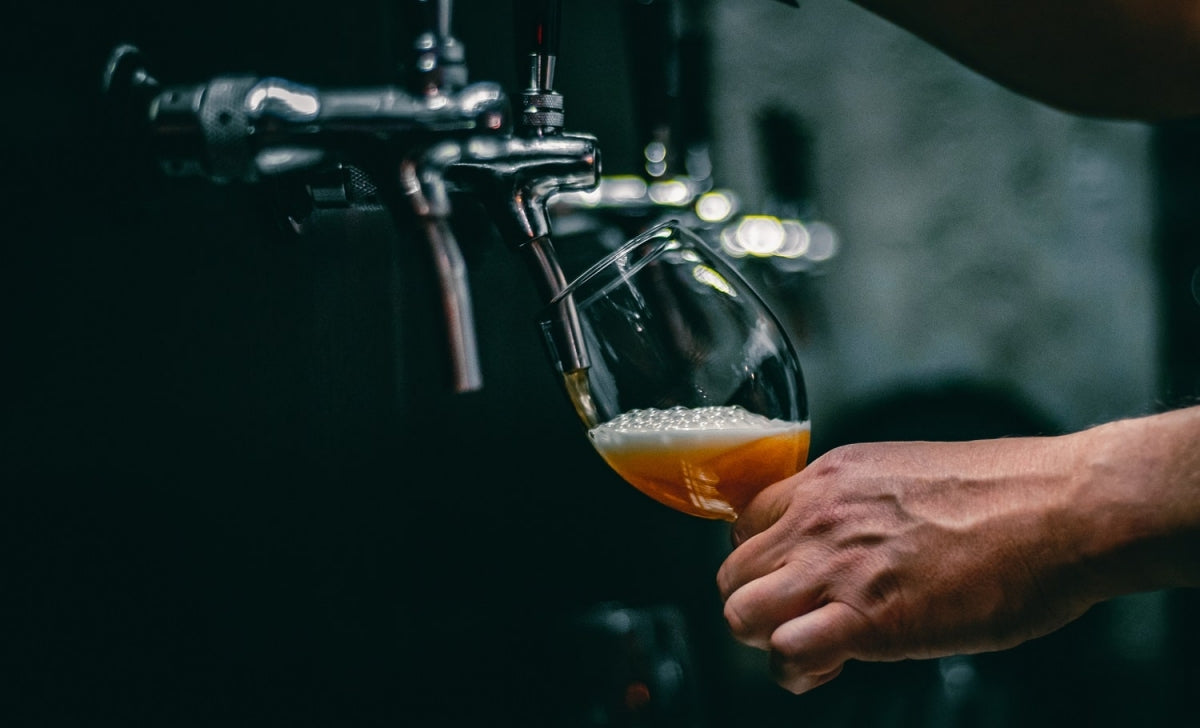
Few things are as satisfying and exciting as pouring the first drops of your homebrewed beer. When you choose kegs over bottles, you obviously need a way to get the beer out. Once you have carbonated and chilled it, there are several ways to serve it. Taps, beer towers or Lindr? Let us look at the many ways to get the beer out of the keg!
Picnic tap and anti-foam tubing
Most people starting out with kegs invest in a keg kit with a cornelius keg, which contains everything you need to get started. These kits also include a beer line with a picnic tap. This is by far the simplest and cheapest way to serve beer from the keg.
The beer line comes in two versions, a regular line and an “anti-foam” line. The main difference is that the line kit with anti-foam tubing has a smaller diameter and gives more resistance. The resistance helps prevent foaming when you pour, and is almost a must if you like highly carbonated beer. You also avoid having to reduce the pressure before pouring to prevent foam, and having to raise the pressure after pouring so the beer does not lose carbonation. That is why we always recommend a beer line with anti-foam tubing.

Picnic Tap 2.1
A new and good alternative to a beer line kit with a picnic tap and anti-foam tubing is the Picnic Tap 2.0 from Homebrewer LAB in California. This is an innovative tap that connects directly to the cornelius keg, with built-in flow control that reduces foaming. Another advantage of the Picnic Tap 2.1 is that the tap does not drip after pouring.

Beer towers, shanks and taps
A picnic line is practical and convenient, but sooner or later many people want a beer tower. The range is large, and the choice comes down to how many taps you want, where the tower will be mounted and, perhaps most important of all, what you like the look of.
If you choose a DIY solution with a tap but no tower, you also need a shank. Put simply, this is a fitting where one end attaches to the tap and the other end connects the beer line to the keg. Shanks also come in several lengths, so you can mount them wherever you like, for example through a fridge door or a wall.
Some beer towers come with taps included, while others let you choose your own. Perlick and Ultratap are affordable options that work very well and give little foam. They are also «forward sealing» taps, which close at the front, unlike vented taps. When the tap closes at the front, you avoid the mechanism getting sticky and, in the worst case, seizing up completely, and cleaning is much easier.

If foam should still be a problem with these taps, there are taps with «flow control», such as the very good Intertap Flow Master, which lets you adjust how fast the beer comes out of the tap and reduces foaming.
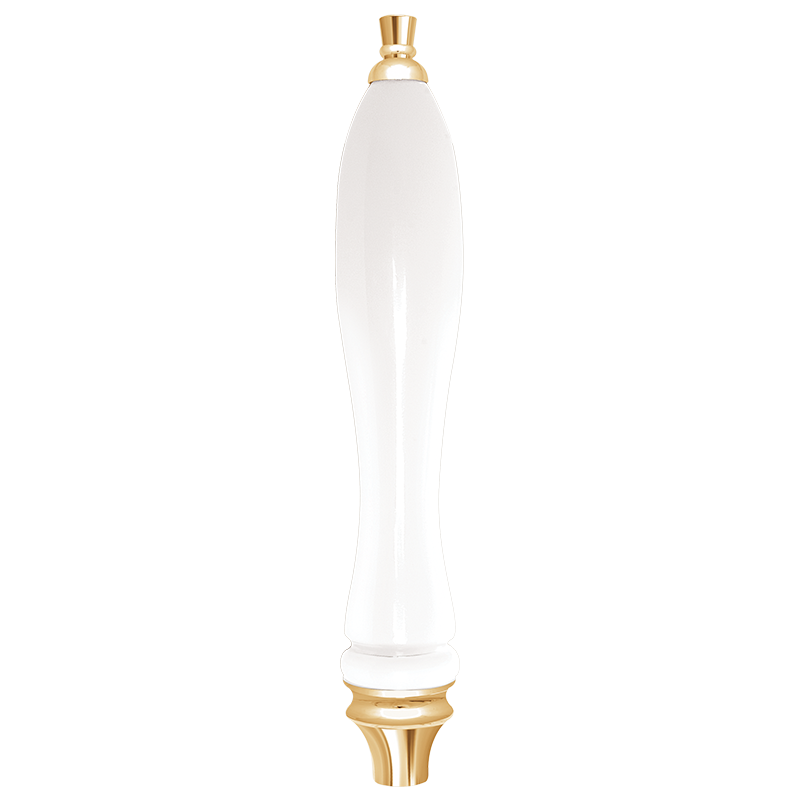
The taps come in different colours and finishes, so just pick whatever you think looks best. Feel free to pimp them up with fresh handles in chameleon paint, chrome or chalkboard, or use traditional handles if you prefer.
Remember to use a drip tray under the tap to save yourself some cleaning. You can also consider getting a tap cap to put on when the tap is not in use, to keep out fruit flies and the like.
With a beer tower, or shanks and taps, you need the beer to be cold. Fortunately, there are many clever solutions for chilling the beer!
Kegerator – a complete fridge for beer kegs
A kegerator (keg + refrigerator) is a fridge with room for one or more cornelius kegs, holes for lines and a tap. It is up to you as the brewer how you want to set it all up. Some choose to bolt a beer tower on top of the fridge, or build the fridge into a bar counter or similar. Another solution is to drill holes in the fridge door and fit shanks with taps on the front. If you are a bit handy and creative, the possibilities for integrating a kegerator are endless.
To make it really simple, there are also ready-made kegerators with room for several cornelius kegs, where everything you need is included. That means everything from a matching beer tower to taps, shanks, lines and CO2 regulator. In other words, all you need is kegs, CO2 and, last but not least, beer. We stock high-quality Kegmaster Series XL kegerators from Keg King in Australia, which come with beer and CO2 lines pre-fitted, including ball lock quick disconnects.

Keezer and Inkbird
A keezer (keg + freezer) is exactly the same as a kegerator, but as the name suggests, a chest freezer is used instead. A freezer often has more room, which means space for more kegs at once.
Freezers are designed for much lower temperatures than a fridge, so we need to do something about the thermostat. Unless you have a technical background, we recommend not tinkering with the thermostat yourself. It is better to use a temperature controller such as the Inkbird ITC 308 with wifi.
You plug the freezer into the Inkbird and place the temperature probe inside the freezer. You set the temperature on the Inkbird or via the app, and it then controls the temperature by starting and stopping the freezer. It can also be a good idea to put the probe in a container of water, so it keeps a steady temperature and avoids big swings when you open the freezer.
Lindr – compact beer towers with cooling
Not everyone has room for a large fridge, but there are smaller and more compact solutions. Beer towers from Lindr are mobile, stylish and highly efficient. The built-in cooling chills the beer on its way from the keg to the tap.
Lindr beer towers come in several versions, which at first glance can be a little hard to tell apart. The key is to pay attention to the number in the name. The number tells you the capacity – how many litres per hour the cooler can handle. So a Lindr 40, in other words, can chill 40 litres of cold beer per hour.
For a homebrewer, a small Lindr tower with 25 litre capacity and one or two taps will usually be enough. There are also larger coolers that can chill several lines at once and handle larger volumes, but these are mainly aimed at breweries, pubs and bars.

Do I need a Lindr with an air compressor?
Some of the Lindr beer towers also come with an air compressor. For homebrewers using cornelius kegs or similar, a compressor is not very useful, as air and beer are a bad combination. Unless you are going to empty the whole keg the same evening, CO2 is a much better way to push the beer out of the keg.
PolyKeg and KeyKeg are one-way kegs made of PET plastic, mainly aimed at breweries producing larger volumes than homebrewers usually do. It is for these kegs that a compressor is a good solution. These kegs hold the beer in a bag inside that is compressed with air pressure to push the beer out, so the beer itself never comes into contact with air. If you want to be able to serve from kegs you can buy directly from breweries, a Lindr with a compressor is handy to have.
Foam problems
Now and then you may get a bit too much foam from a tap, but fortunately there is often a simple solution.
1. Too much pressure in the keg. When you carbonate beer you may often use high pressure, but when serving you should turn the pressure down a little and pull the pressure relief valve to reduce the pressure in the keg. Around 0.8 BAR will work on most systems.
2. Flow control. Some taps come with flow control, a small lever on the tap that lets you adjust the flow rate. Experiment and you will find the perfect setting for your beer. There is also inline flow control that can be fitted directly on the line and adjusted from there.
3. Lines that are too short or too wide. Narrower and longer lines create more resistance, and this resistance reduces foaming. Even though it is tempting to use short lines so everything looks tidy in your fridge, at least 1.5–2 metres of line will work wonders. We recommend 3/16” inner diameter LDPE tubing for the best results. This is the same tubing we use in our beer line kit with anti-foam tubing.
4. Temperature too high. Make sure your keg is well chilled before you pour. If your taps are in a very warm room, or you pour beer on the hottest summer days, the tap itself can also warm up. Pouring off a splash to cool the tap down will often solve this.
5. The dip tube is blocked. If a lot of hops and sediment came along when you transferred from the fermenter to the keg, the thin dip tube can get blocked. You can easily fix this by moving the gas disconnect to the beer-out post and blowing the dip tube clear with gas. To avoid carrying over a lot of sediment when transferring to a keg, we recommend a Bouncer Inline Beer Filter fitted on the hose between the fermenter and the keg.
6. The beer may simply be over-carbonated. This makes it harder to pour without foam. Try the tips above, or turn the pressure on the keg down considerably more. If that does not help, you can disconnect the gas and pull the pressure relief valve in the keg lid until all the pressure is gone. Shake the keg a little so the beer releases carbon dioxide. Wait a while until the foam has settled, and release the pressure again. Repeat this until you reach the carbonation level you want, and it can take a while.
Read our blog on carbonating beer in a keg to learn more about this.
Cleaning taps and beer lines
Over time, both taps and lines will benefit from a good clean. If they are not cleaned often enough, you will see residue and discolouration in the lines or, in the worst case, get unpleasant flavours in your beer. A good routine is to clean your dispensing system every time you change kegs.
The taps can be taken apart and cleaned in hot water and PBW or similar. Use a small brush to reach all the nooks and crannies where old beer can collect, and leave the parts to soak in the PBW solution for a while. Rinse well with clean water and leave to dry. Also check that the seals are intact, and replace them if needed.
For lines and beer lines we recommend Ansep BLC from Ecolab, a very effective cleaner specially designed for lines and beer lines. Ansep BCL also has a unique feature in that it changes colour as it works.
How to clean your beer lines:
1. Fill a keg or similar with lukewarm water and Ansep BLC according to the instructions on the bottle.
2. Pump the diluted Ansep BLC through the beer line until purple liquid comes out of the tap. Leave it for five minutes, then pump liquid through until it turns purple again. The liquid that comes out first will now have changed colour from purple to grey-green.
3. Leave the liquid for another five minutes, and repeat the process until it no longer changes colour. Rinse through with a few litres of clean water to get all the cleaner out, and your beer lines are ready to use again.
4. Ansep BLC can be used on all beer lines and taps, including Lindr beer towers.
5. Star San or other acid-based cleaners should be avoided, as plastic parts such as John Guest push-fit connectors can become brittle and, in the worst case, break on contact with acid. The result can be messy if it is the connectors on the beer line itself that fail. If you still want to use Star San, we recommend rinsing with water afterwards.
If you are missing anything, you will find everything you need for cleaning your brewing equipment in our range.