While West Coast IPA ruled the USA in the late 90s and the early years of the millennium, with caramel notes, citrus and piney character, and IBUs that were ideally in three digits, brewers on the East Coast (New England) were at the same time experimenting with late hop additions.
In January 2004 The Alchemist brewery launched what is considered the first New England IPA (NEIPA). This was «Heady Topper», which still has legendary status within the style today and stands as the very prototype of the New England IPA. Over time the concept slowly spread along the East Coast, and this is where breweries that have since become famous, such as Hill Farmstead, Trillium, Treehouse, Other Half, Tired Hands and many more, come in. Today you will hardly find a single brewery that does not have a NEIPA or ten in its log.
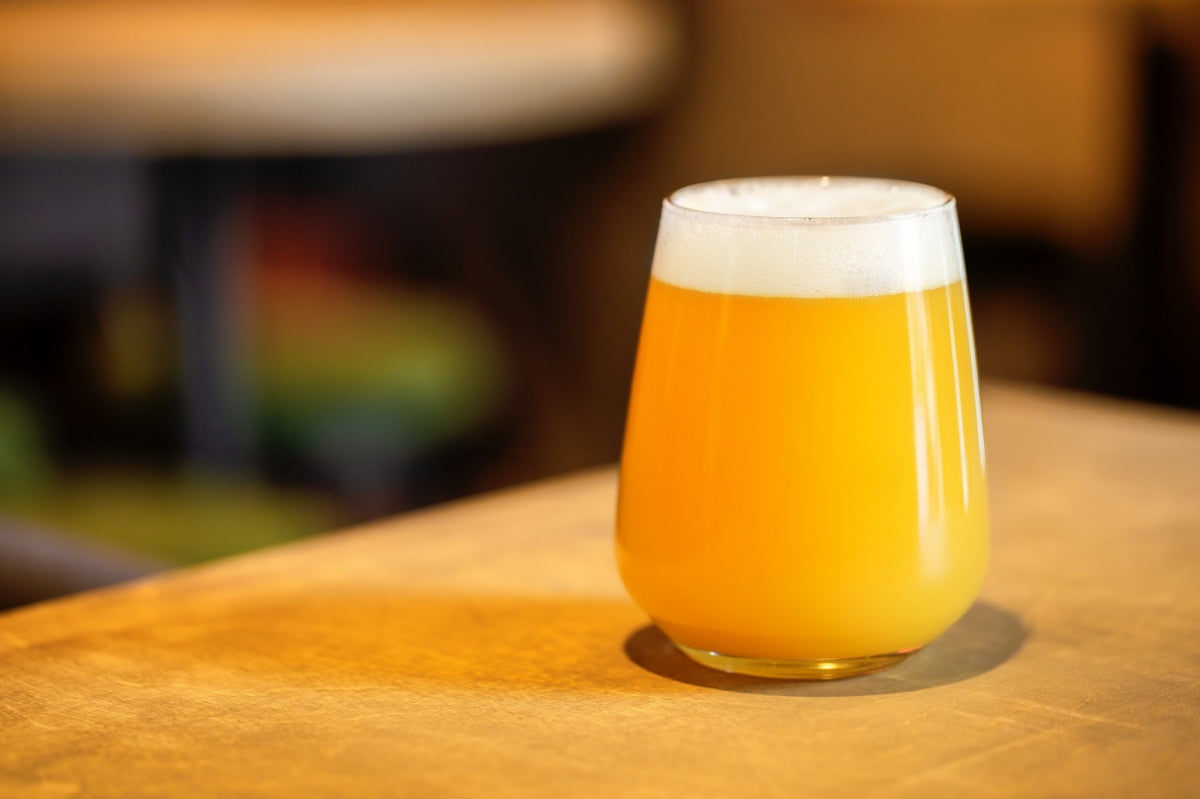
The beer style is a further development of the classic IPA, but stands out with its bright yellow hazy colour, velvety mouthfeel, low bitterness and, not least, because it is a pure flavour bomb of tropical fruit and citrus. The big hop flavours are volatile and break down relatively quickly. In other words, this type of beer is a fresh product that should be drunk fairly quickly. If you keep the beer cold after fermentation, it will keep even longer.
Ingredients for NEIPA
Malt:
NEIPA can be brewed in many ways, but the most common is a simple base malt (pilsner or pale), a large proportion of wheat, and often flaked oats and wheat. These components give a sweetish base with flavours hinting at white bread, biscuits and honey, and with the large proportion of wheat and oats the result is often a very cloudy (hazy) wort.
Some also prefer a more solid malt base, using for example maris otter or golden promise to give more flavour and complexity to the base, or a little specialty malt such as biscuit or carapils.
Hops:
Here hopheads have free rein, and you can pick and choose. Hops with big tropical fruit flavour profiles are often used. Think American varieties such as Citra, Mosaic and Centennial, or more exotic varieties such as Galaxy and Vic Secret. Even though these hop varieties often have high alpha acids (bitterness), they should mainly be added right at the end of the boil (whirlpool/hopstand), with a good proportion used for dry hopping. Often several dry hop additions at different times, to bring out different flavours during fermentation (double dry hop, commonly abbreviated DDH).
Part of the hops is often added after a few days of fermentation, while the yeast is at its most active. With this addition the hop oils react with the yeast, and we bring out even more depth and flavour thanks to the phenomenon of biotransformation.
Yeast:
Although WLP001/US-05 and WLP013/S-04 are simple and safe choices for NEIPA, demand for yeast strains suited to this style has grown enormously. Today we have loads of great yeast strains that not only showcase the hops to the full, but also contribute their own fruity flavours to balance it all. Yeast specially selected for NEIPA and other hazy beer styles also stays in suspension, which means the beer becomes even more hazy (cloudy).
Vermont Ale from The Yeast Bay is isolated from an (unknown) popular double IPA from the Northeast, and is a safe bet here. Also take a look at WLP066, which is an exciting and popular alternative.
If we look at dry yeast strains, there are also good choices here, such as Lalbrew New England, Lallemand's Verdant IPA and of course the classic S-04 from Fermentis. Here it is simply a matter of experimenting.
Don't forget the water!
If there is one beer style that really benefits from the right water profile, it is NEIPA. The right adjustment here can let the hops shine and give a velvety mouthfeel. Feel free to check out our article on water adjustment to get a little further into this subject. How to approach it is both debated and, not least, a matter of personal preference, but most people prefer to let calcium chloride take the lead. If you use Brewfather, it includes a couple of good NEIPA water profiles that can be recommended as a starting point, and you can then experiment according to your own taste.
Avoid oxidising your NEIPA
Also be aware that NEIPA can be a little demanding to brew, mainly because of the high risk of oxidation. Then we go from a delicious, yellow tropical hop bomb to a browner colour spectrum. The powerful hop flavours become very muted, and you get flavours reminiscent of wet cardboard instead. The best thing you can do to avoid this is to use a Cornelius keg.
If you carbonate in bottles, the oxygen left in the bottle when you cap it will be enough to affect the beer and push oxygen into it. You can happily bottle NEIPA if it is to be drunk within a couple of weeks, but much longer than that can become problematic. Also avoid all splashing and stirring of the beer after fermentation, for example with a siphon, stirring in a sugar solution, or too much of a drop when transferring from fermenter to keg. The best solution is a closed transfer to a keg, and there are several ways of doing this depending on the equipment you have.
NEIPA – your next brew?
All things considered, this is a fantastic beer style that exploded onto the market a few years ago and has since claimed its place. It is also a great style if your freezer is full of leftover hops that need using up, given that it takes relatively large amounts of hops. Or take advantage of our volume discount (20%) on all our hop varieties when buying 5 or more, and use our freshest vacuum-packed and frozen hops.
In short, this is a style you can really play with if you love hop juice!
In our large range of all-grain beer kits and fresh wort kits, we of course have many New England IPAs to choose from.

|
 |